Masterpiece
Carnation, Lily, Lily, Rose: Painting Twilight
Sargent turned a few minutes of evening light into a painting that required patience, repetition, and two summers outdoors.

A narrow window of light
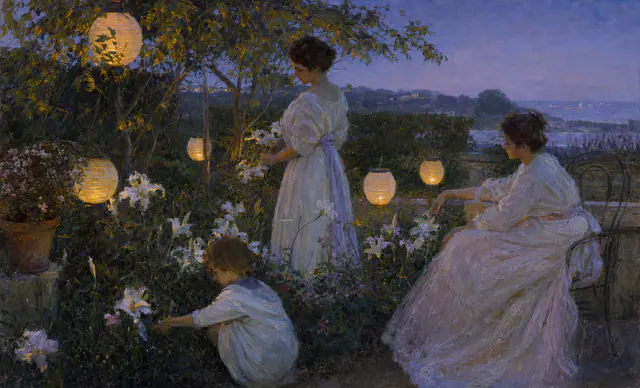
Carnation, Lily, Lily, Rose shows two children lighting Japanese lanterns in a flower-filled garden. Its subject appears gentle, but its making imposed a severe constraint: Sargent wanted the particular balance of natural and artificial light found at dusk.
That balance lasts only minutes. Working outdoors in the English village of Broadway, he returned repeatedly at the same time of day. The painting developed through short sessions across the summers of 1885 and 1886 rather than through one prolonged act of improvisation.
The garden as a field of repeated shapes
The flowers are not merely botanical decoration. Pale lilies, rounded lanterns, and the children's dresses create a rhythm of light forms against green. Vertical stems hold the surface together while the figures remain embedded in the garden rather than standing in front of it.
Sargent's cropping intensifies the experience. There is little distant landscape and no conventional horizon to organise the scene. The viewer enters a dense field in which near and far are compressed by pattern.
Natural light meets lantern light
Twilight makes colour relationships unstable. The remaining sky light is cool, while the lantern interiors are warm. The children's faces and dresses sit between these sources. Sargent avoids turning the lanterns into theatrical spotlights; their glow remains part of a broader atmosphere.
The painting's magic is therefore not a single effect but a threshold. Day has not ended, night has not fully begun, and the figures are absorbed in the small action that joins the two.
Look beyond the prettiness
The flowers and children can make the painting seem instantly charming. Look longer at its discipline: the repeated returns to one light condition, the cropped structure, and the careful distribution of pale shapes. What feels effortless is the result of sustained editing.
That tension between immediacy and construction appears throughout Sargent's work. The visible surface offers pleasure first; the underlying decisions reward the slower visit.