Technique
John Singer Sargent’s Watercolour Technique
Transparent wash, untouched paper, graphite, opaque accents, and radical selection made Sargent's travel watercolours feel immediate.

A portable practice with serious ambition
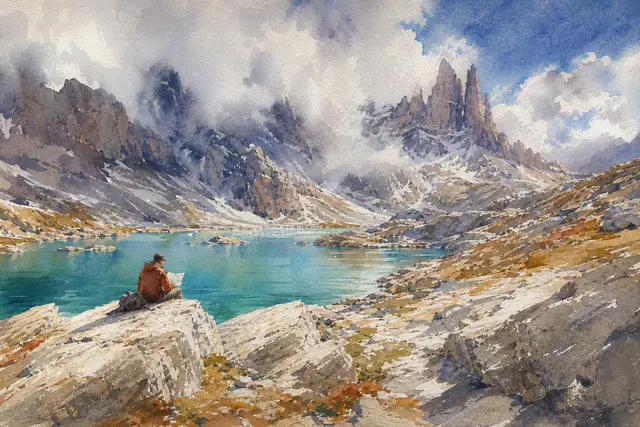
Sargent's watercolours are sometimes described as relief from the demands of commissioned portraiture, but they are not casual leftovers. Travel gave him different subjects and different freedoms: mountain water, boats, gardens, architecture, companions at rest, and light changing too quickly for prolonged revision.
After reducing his portrait commissions around 1905, he devoted increasing energy to travel, murals, and works on paper. Museums now hold large groups of these sheets, revealing a practice built on speed but supported by decades of disciplined observation.
Let the paper produce the brightest light
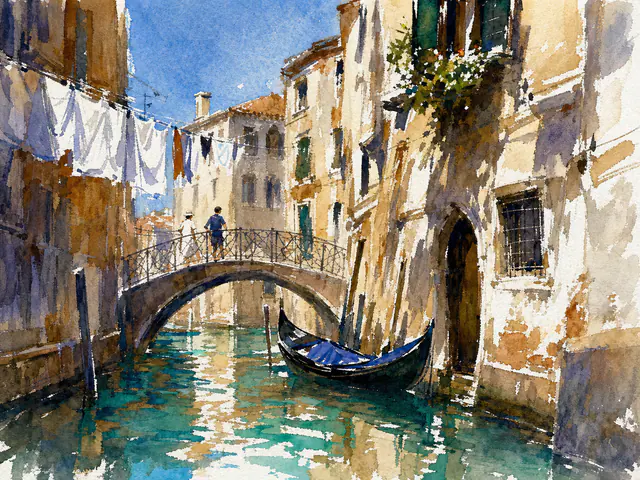
In transparent watercolour, the white of the paper is the strongest available light. Sargent often planned around it, leaving passages untouched or painting around narrow shapes that would later read as glitter, spray, pale stone, or sunlit cloth. The light is not applied at the end; it is preserved from the beginning.
This creates a productive risk. A misplaced wash cannot be fully reversed. The apparent spontaneity depends on choosing what not to cover and accepting that some edges will remain open.
Combine drawing, wash, and opacity
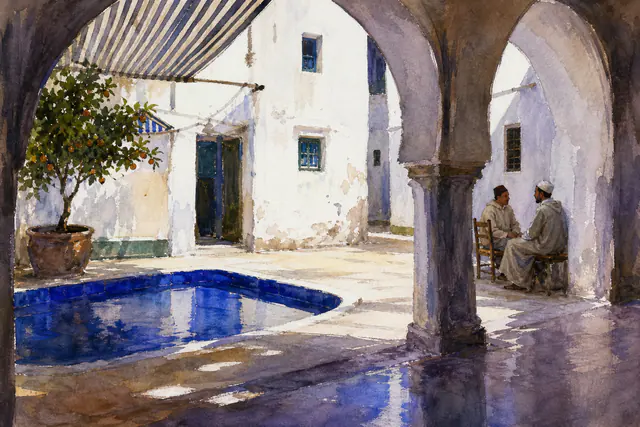
Graphite can establish a bench, façade, or figure with only a few coordinates. Transparent washes organise the largest colour relationships. Darker touches arrive where structure needs emphasis, while occasional opaque passages can recover a light accent or give a surface more body.
The methods are mixed according to the subject rather than kept doctrinally pure. In a Venetian view, a loose reflection may matter more than architectural detail. In a garden, one pale shape can carry the sensation of heat while most foliage remains broadly grouped.
Selection is the real technique
Sargent's sheets often feel complete because the chosen information is decisive, not because every object is finished. He identifies the visual event—the flash on water, the cool opening beneath an arch, the pattern of bodies on a bank—and lets less important passages remain abbreviated.
When looking at a watercolour, ask where the paper is still visible, where the darkest dark occurs, and which forms are described only by adjacency. These choices reveal the construction beneath the fluency.